

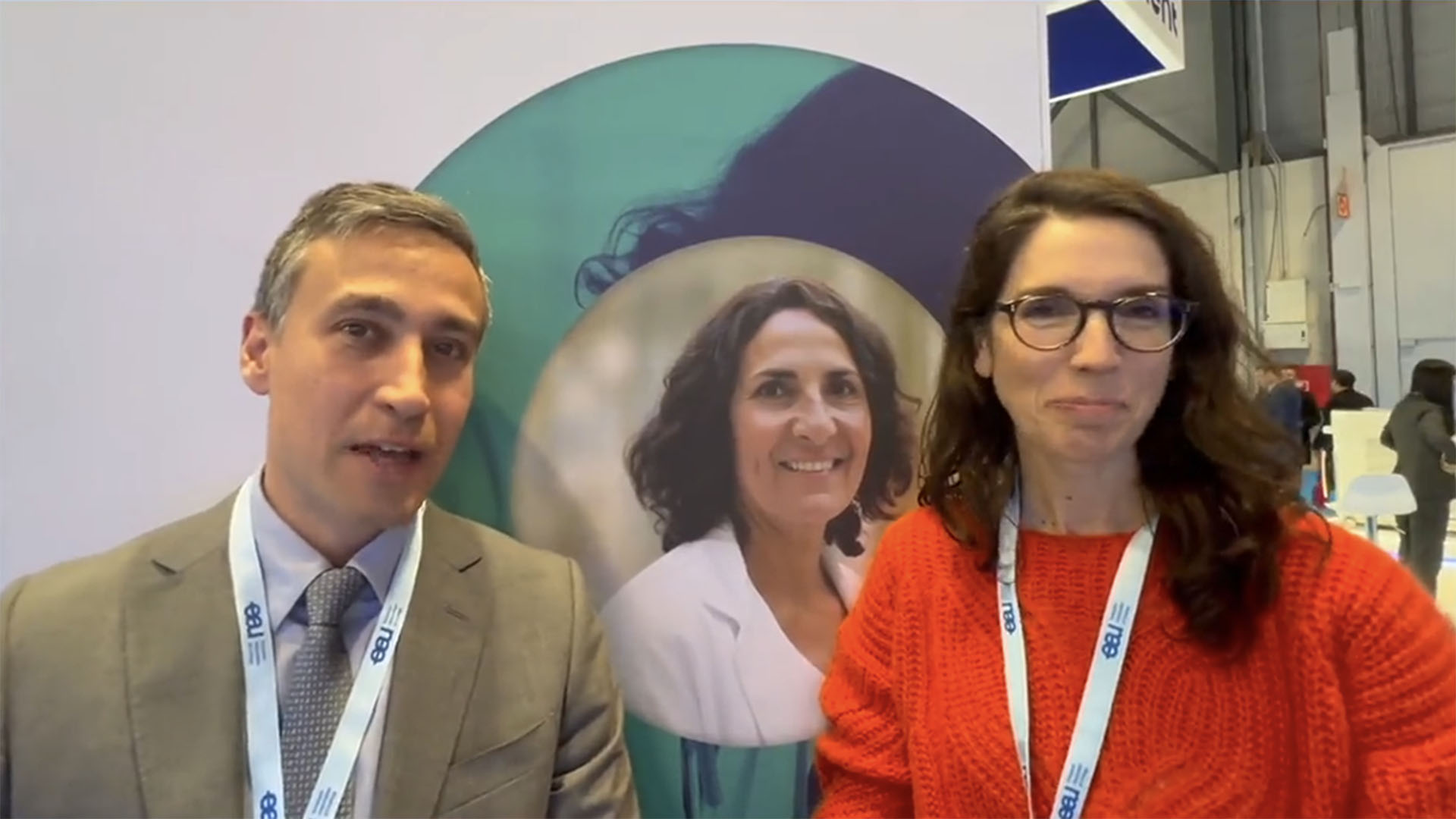
At EAU 2025, Dr. Alexandra Masson-Lecomte, a leading expert on the urothelial cancer guidelines, addresses the complex question of how to manage synchronous upper and lower tract urothelial cancer. Focusing on patients with high-grade urothelial cancer, she details a practical, sequential treatment strategy not yet covered in official guidelines.
Transcript
Interviewer
Hello everyone and welcome to the EAU 25 here in Madrid, Spain. My name is David Anderer, urologist from Vienna, Austria, and it’s my distinguished pleasure to welcome with us today Alexandra Masson-Lecomte. Uh, she is full professor of urology at the Hospital Saint-Louis in Paris and the chair of the upper tract urothelial cancer guidelines. Alexandra, thank you very much for being with us today.
Dr. Alexandra Masson-Lecomte
You’re welcome.
Interviewer
Uh, I would like to discuss with you some technical aspects of upper tract. So, uh, how do we deal in the case of, uh, synchronous upper tract and lower tract high-grade urothelial cancer? Can you give us some insights and also from your clinical practice point?
Dr. Alexandra Masson-Lecomte
Sure. So this is not, um, a subject that is treated in the guidelines at all because, uh, we do not have literature on that. So it’s really a clinical question. And it’s funny that you ask me about it because this is, I think, the questions that colleagues from France write to me the most about, how do I manage concurrent upper tract and lower tract tumors? So, in the setting of, um, a high-grade tumor that is going to be both in the bladder and in the upper tract, it’s a difficult situation.
Dr. Alexandra Masson-Lecomte
Um, obviously, the way you’re going to manage it depends first on which of the tumors is the more aggressive, but also the fact that when you do a radical nephroureterectomy, you really want to remove the bladder cuff, which you cannot do if you have a bladder tumor in.
Dr. Alexandra Masson-Lecomte
So, what I usually try to do, but I mean, there’s not only one way to manage those patients, but what I usually try to do is to manage the patient, the bladder first with TUR, complete TURBT, then check the bladder, make sure that it’s clear. Once the bladder is clear, few weeks afterwards, you have to do a quite a quick sequence. I go with the radical nephroureterectomy and since the bladder was cleared a few weeks before, I do the bladder cuff, I remove the ureter because if you leave the, the small part of the ureter, you’re going to have a very high amount of recurrence in that area, which are quite difficult to manage. And then afterwards, a few weeks after, if there is a need for adjuvant instillation for the bladder, then I start the instillations. So I’m going to go TURBT, then RNU with bladder cuff, then bladder instillation. That is a way to manage it.
Dr. Alexandra Masson-Lecomte
Um, in an alternative situation where for some for reason you really want to manage the upper tract first because the patient is bleeding, because there is an emergency, uh, um, because it’s a big tumor, it’s highly aggressive, I don’t know, then the only alternative is to perform the RNU without opening the bladder, so you would have to go really deep down deep the ureter but not opening the mucosa, leaving the bladder closed so you don’t have any spilling, and manage the bladder and the ureter secondly, the the meatus that you can resect, uh, secondly as a, as a second step. But usually I prefer to use the first approach.
Interviewer
Great. So thank you very much for sharing with us this very practical aspect on how to manage, uh, upper and lower tract high-grade urothelial cancer. I wish you a, a great congress and thank you for being with us today.
Dr. Alexandra Masson-Lecomte
You’re welcome.


